
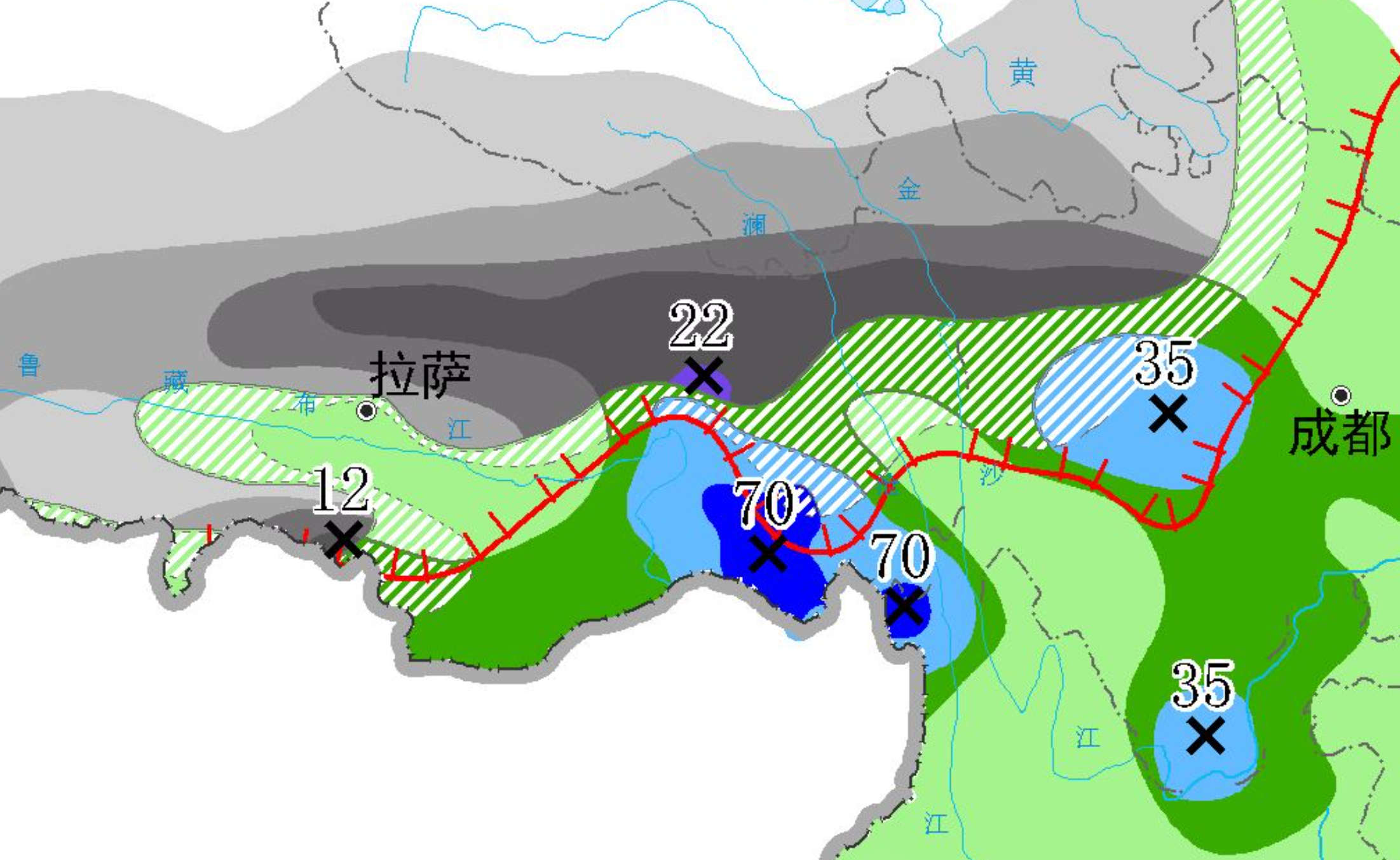
China’s meteorological disasters (heavy snow, rain, smog, cold air, Typhoon “Haiou”) from October 27 to November 2, 2025. It details their causes, impacts on transport/agriculture/energy, and disaster chains, offering scientific support for disaster prevention.
1. Report Overview
This week (October 27 to November 2, 2025), China experienced complex weather conditions: the eastern Qinghai-Tibet Plateau saw continuous heavy snow and rain, intense rainfall hit the southwest to Hainan Island, while northern China faced sharp temperature drops and smog. Based on authoritative weather bulletins from the China Meteorological Administration (CMA) and the “three-element theory of disaster systems” (hazard-causing factors, exposed elements, disaster-prone environment), this report systematically analyzes the causes, impacts, and risk chains of major meteorological disasters, providing scientific references for disaster prevention and mitigation.
2. Overview of This Week’s Disaster Events
Over the past week, China was affected by four types of meteorological disasters, impacting multiple regions and disrupting transportation, agriculture, energy supply, and daily life. The table below summarizes the key details of these disasters:
| Disaster Type | Main Affected Areas | Key Hazard-Causing Factors | Main Impacts |
|---|---|---|---|
| Heavy Snow | Eastern Qinghai-Tibet Plateau, Northeast China | Heavy snow (moderate to heavy snow, local blizzards), low temperatures | Traffic disruptions, damage to agriculture and animal husbandry, risk of power outages |
| Heavy Rain | Southwest China, Hainan Island | Intense rainfall (heavy to downpours) | Floods, geological disasters, traffic interruptions |
| Smog | South-central North China, Huanghuai Region | Heavy fog (visibility < 500m), haze | Traffic disruptions, health risks, flight delays |
| Cold Air | Most of Northern China | Strong winds, temperature drops (4-8℃) | Increased energy demand, maritime navigation risks, health risks |
Table 1: Summary of Major Meteorological Disasters in China (October 27 – November 2, 2025)
3. Disaster Analysis
3.1 Analysis of Heavy Snow Disasters
3.1.1 Analysis of Hazard-Causing Factors
- Snow Intensity: The eastern Qinghai-Tibet Plateau suffered continuous heavy snow. Moderate to heavy snow or sleet hit central-eastern and southwestern Tibet, southern Qinghai, and northern Western Sichuan Plateau; some areas experienced blizzards, with local extreme blizzards (snowfall of 30-35 mm). Northeast China also saw significant snow, with heavy snow in parts of western and southern Heilongjiang and eastern Jilin. (Source: CMA Official Website)
- Duration and Scope: Snowfall began on October 31 and lasted until November 2, covering parts of the eastern Qinghai-Tibet Plateau and Northeast China. By November 2, snow and rain in the eastern Qinghai-Tibet Plateau gradually subsided. (Source: CCTV News Channel)
3.1.2 Analysis of Disaster-Prone Environment
- Terrain and Atmospheric Conditions: The high altitude of the Qinghai-Tibet Plateau provided a low-temperature foundation for snowfall. Meanwhile, the active southern branch trough continuously transported warm, moist air, which converged with cold air over the plateau, creating favorable conditions for heavy snow. Snow in Northeast China was mainly driven by cold vortex systems, as cold air moved southward and combined with local climatic conditions.
- Climatic Background: This blizzard occurred from late October to early November, a rare intense snow event for the same period in history. The eastern Qinghai-Tibet Plateau typically enters its snow season in this period, but such extreme intensity is uncommon. (Source: The Paper)
3.1.3 Exposed Elements and Impacts
- Transportation: Heavy snow severely disrupted road traffic, affecting key highways in Northeast China such as G10 Suiman Expressway and G1011 Hatong Expressway. Railway and airport operations were also hit, causing delays or cancellations.
- Agriculture and Animal Husbandry: Low-temperature snow disasters threatened animal husbandry, risking livestock freezing and feed shortages. Protected agriculture also faced risks—heavy snow accumulation could collapse greenhouses and livestock shelters, causing property damage and production halts.
- Power and Communications: Snow might damage power lines and communication facilities, especially in mountainous areas with complex terrain, increasing repair difficulty and time. (Source: CMA Official Website)
3.2 Analysis of Heavy Rain Disasters
3.2.1 Characteristics of Hazard-Causing Factors
- Rainfall Intensity: Intense rainfall hit the southwest to Hainan Island. Heavy rain or downpours occurred in southeastern Tibet, southern Sichuan, western-central Yunnan, and southeastern Hainan. From 8:00 on November 1 to 6:00 on November 2, moderate to heavy rain fell in southern Sichuan, southwestern Chongqing, southeastern Tibet, and northwestern-southern Yunnan, with local heavy rain in northwestern-southern Yunnan. (Source: CCTV News Channel)
- Temporal and Spatial Distribution: Rainfall started on October 31 and lasted until November 4, affecting Southwest China, Jiangnan, Huanghuai, Jianghuai, Guangxi, and Hainan Island. The intense rainfall in many parts of Yunnan was rare for the same period in history. (Source: The Paper)
3.2.2 Analysis of Disaster-Prone Environment
- Geographical Factors: Southwest China has complex terrain with numerous mountains and hills, creating conditions for geological disasters. As a tropical island, Hainan is prone to local severe convective weather influenced by tropical systems.
- Meteorological Conditions: Continuous rainy weather in Southwest China was linked to stable moisture transport, while heavy rain in Hainan might be affected by the periphery of tropical systems. Sufficient moisture and unstable atmospheric energy provided favorable conditions for intense rainfall.
3.2.3 Exposed Elements and Impacts
- Transportation: Heavy rain made roads slippery and reduced visibility, endangering driving safety on highways such as G5 Beijing-Kunming Expressway and G56 Hangzhou-Ruili Expressway. Intense rain could also cause waterlogging or road damage, interrupting traffic.
- Geological Disasters: Continuous rainfall, especially in mountainous areas, significantly increased the risk of secondary disasters like landslides and mudslides—exacerbated by Southwest China’s complex terrain.
- Agriculture: Heavy rain might cause short-term waterlogging in low-lying farmland, affecting crop growth and even leading to reduced yields or total crop failure. It could also destroy farm infrastructure, causing economic losses. (Source: CMA Official Website)
3.3 Analysis of Smog Weather
3.3.1 Characteristics of Hazard-Causing Factors
- Fog Features: Heavy fog occurred in parts of south-central North China, Huanghuai, Hubei, and Hunan. Some areas had dense fog with visibility < 500m, and local extreme dense fog with visibility < 200m. From the morning to morning of October 31, dense fog appeared in parts of southern Hebei, eastern Henan, northwestern Shandong, and central-northern Anhui. (Source: CMA Official Website)
- Haze Conditions: Meanwhile, light to moderate haze occurred in Huanghuai, Jianghan, and Jianghuai, significantly worsening air quality. Combined smog persisted in these areas throughout the week.
3.3.2 Analysis of Disaster-Prone Environment
- Meteorological Conditions: Stable weather (low wind speed, stable atmospheric stratification) is typical for such events, as it hinders pollutant diffusion and fog dissipation. Inversion layers further block vertical air movement, trapping pollutants near the ground.
- Human Factors: Besides unfavorable meteorological conditions, haze is closely linked to pollutant emissions from local and surrounding areas. Increased heating activities in autumn may raise emissions, worsening haze. (Source: CMA Official Website)
3.3.3 Exposed Elements and Impacts
- Transportation: Low visibility from fog and haze posed major challenges to highways, airports, and ferry terminals, easily causing chain-reaction rear-end collisions. Sections of highways like G4 Beijing-Hong Kong-Macao Expressway and G5 Beijing-Kunming Expressway were affected. (Source: CMA Official Website)
- Public Health: Haze worsens air quality, harming residents’ health and triggering respiratory diseases—especially affecting children, the elderly, and people with pre-existing respiratory conditions.
- Economic Activities: Low visibility may reduce logistics efficiency and cause flight delays/cancellations, indirectly impacting economic activities and social operation efficiency.
3.4 Analysis of Cold Air Activity
3.4.1 Characteristics of Hazard-Causing Factors
- Strong Winds: Affected by cold air, 4-6 level winds (gusts up to 7-8 levels) hit Northeast China. The sea area off Guangdong Province also saw northeast winds of 6-7 levels (gusts up to 8-9 levels).
- Temperature Drops: Temperatures fell by 4-6℃ in central-eastern Inner Mongolia, North China, Northeast China, and Huanghuai, with local drops exceeding 8℃. Southern China also saw significant cooling due to rainy weather: Guiyang’s maximum temperature dropped to 11℃, Kunming’s to 10℃, and Chongqing’s to 16℃—all potentially the lowest since the second half of this year. (Source: Meteorological Information)
3.4.2 Analysis of Disaster-Prone Environment
- Atmospheric Circulation: This cold air event was mainly driven by westerly belt fluctuations in mid-high latitudes. Cold vortices carrying cold air southward caused strong winds, temperature drops, and snow in Northeast China.
- Geographical Factors: Northern China is frequently affected by cold air in autumn and winter, providing a low-temperature background. Northeast China and central-eastern Inner Mongolia bore the brunt of the cooling, with more significant temperature drops.
3.4.3 Exposed Elements and Impacts
- Maritime Navigation: Strong winds threatened navigation safety in sea areas like the Taiwan Strait, Bashi Channel, East China Sea, and South China Sea. The sea off Guangdong Province required increased caution for maritime traffic and operations.
- Energy Supply: Cooling increased energy demand, straining power supply and heating systems—especially in northern China, where the heating season had just begun.
- Human Health: Sudden temperature drops raised the risk of colds and cardiovascular/cerebrovascular diseases, particularly affecting the elderly and patients with chronic illnesses.
3.5 Analysis of Typhoon “Haiou”
3.5.1 Typhoon Development
A typhoon (“Haiou”) formed in the northwestern Pacific this week. The 25th typhoon of this year, “Haiou” (Tropical Storm level), formed at 20:00 on November 1 over the northwestern Pacific east of the Philippines. At 08:00 on November 2, “Haiou” intensified to a Severe Tropical Storm, with its center located about 1,550 km southeast of Manila, Philippines. The maximum wind force near the center was level 10 (25 m/s), with a minimum central pressure of 985 hPa. (Source: Meteorological Information)
3.5.2 Path and Intensity Forecast
It is expected that “Haiou” will move westward at about 20 km/h, pass through central the Philippines on the 4th, and enter the South China Sea on the 5th. From the 5th to the 7th, it will cross the southern part of the South China Sea toward the central-southern coast of Vietnam, gradually intensifying to Typhoon or Severe Typhoon level (level 13-15). During this process, its center will be about 700 km from Guangdong Province (about 1,000 km from Guangzhou), with no direct impact on Guangdong’s land or offshore areas. (Source: Meteorological Information)
3.5.3 Potential Impacts
Although Typhoon “Haiou” will not directly affect China’s land or offshore areas, its peripheral circulation may bring strong winds to the South China Sea, affecting maritime navigation and operations. Meanwhile, typhoon activity may alter the atmospheric circulation pattern, indirectly influencing weather in other parts of China.
4. Disaster Chains and Secondary Impacts
4.1 Disaster Chain Relationships
This week’s meteorological disasters were not isolated but formed complex disaster chains, amplifying overall impacts. The table below shows key disaster chain relationships:
| Main Hazard-Causing Factors | Direct Impacts | Secondary/Derived Impacts | Potential Long-Term Impacts |
|---|---|---|---|
| Heavy Snow | Traffic interruptions, snow-induced structural collapses | Disrupted material supply, losses in agriculture/animal husbandry, increased energy demand | Economic losses, market fluctuations |
| Heavy Rain | Urban waterlogging, farmland waterlogging | Geological disasters, water pollution, pests/diseases | Reduced agricultural yields, infrastructure damage |
| Smog | Low visibility, poor air quality | Traffic accidents, health damage, flight delays | Increased medical burden, reduced labor productivity |
| Strong Winds & Cooling | Discomfort to humans, rough seas | Surge in energy demand, maritime risks | Tight energy supply, disrupted trade |
Table 2: Meteorological Disaster Chains and Secondary Impacts
4.2 Analysis of Transportation Impacts
- Land Transportation: Heavy snow closed or restricted highways in Northeast China; heavy rain caused landslides or waterlogging on roads in Southwest China; heavy fog led to traffic controls on multiple highways in the North China Plain.
- Air Transportation: Low visibility caused flight delays or cancellations, with airports in North China most affected.
- Maritime Transportation: Strong winds disrupted maritime navigation, threatening safety in sea areas like the Taiwan Strait, Bashi Channel, East China Sea, and South China Sea.
4.3 Analysis of Agricultural Impacts
- Protected Agriculture: Heavy snow and cooling threatened protected agriculture, potentially damaging greenhouse structures and affecting crop growth inside.
- Animal Husbandry: Low-temperature snow disasters endangered livestock in pastures, risking freezing deaths; difficulties in feed transportation further strained animal husbandry.
- Farmland Waterlogging: Heavy rain caused waterlogging in low-lying farmland, affecting crop root respiration and leading to reduced yields or plant death.
4.4 Impacts on Energy and Infrastructure
- Energy Supply: Cooling increased heating demand, straining power grids and energy supply systems. Meanwhile, snow and rain might damage power facilities, causing outages.
- Urban Operations: Heavy rain could cause urban waterlogging, disrupting travel and normal urban functions. Heavy fog also reduced urban traffic efficiency.


Leave a Reply