
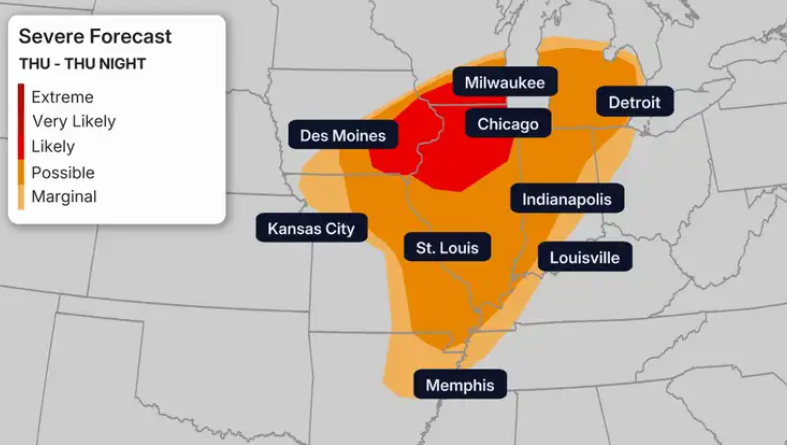
A multi-day severe storm threatens 8 U.S. states with tornadoes, 60mph winds and floods this week, coinciding with spring break travel. The historic Tornado Alley is shifting east to more populated areas, requiring updated preparedness for young people.
Spring break road trips and Easter celebrations are at risk as a relentless storm system barrels across the United States, bringing the first major tornado outbreak of the 2026 season. For millions of young people—especially those in the Midwest and East who rarely faced tornado threats growing up—this is a critical wake-up call: the map of tornado risk in America is fundamentally changing, and old assumptions about where tornadoes happen no longer apply.
This Week’s Immediate Tornado Threat
AccuWeather warns that the storm system will impact at least 8 states across the Southern Plains, Midwest and Great Lakes, including Texas, Oklahoma, Kansas, Missouri, Illinois, Indiana, Ohio and Michigan. The threat will unfold in waves through Easter Sunday:
- Thursday: Severe thunderstorms will hit the Midwest, bringing 50+ mph gusts, large hail and isolated tornadoes near major cities including Chicago, St. Louis, Indianapolis, Milwaukee and Detroit.
- Friday: The threat shifts south and expands, with 60+ mph damaging winds, flash flooding and scattered tornadoes possible from central Texas north to southwest Wisconsin and west Ohio.
- Through Sunday: Storms will track east toward the I-95 corridor, causing widespread travel disruptions just as millions of Americans return from spring break.
“This is not a one-day event—it’s a rolling wave of severe weather that will last nearly a week,” said AccuWeather senior meteorologist Bill Deger. “With millions of people on the roads and in airports for the holidays, even minor storms can cause major chaos.”
Tornado Alley Is Moving East
The most important long-term trend is that the traditional “Tornado Alley”—long centered on the Great Plains states of Texas, Oklahoma, Kansas and Nebraska—is shifting dramatically eastward.
A 2024 peer-reviewed study found that since 1985:
- Tornado counts in parts of the traditional Great Plains corridor have dropped by up to 40%
- Tornado activity has increased by ~25% in Mississippi, Tennessee and the Ohio River Valley
- “Cold-season tornadoes” (September–February) now make up 28% of all U.S. tornadoes, up from 20% historically, with nearly all of this increase occurring in the East
Scientists link this shift to climate change: rising global temperatures have increased humidity levels in the eastern U.S., while shifting atmospheric patterns have moved the key ingredients for tornado formation—wind shear (changing wind speed/direction with height), unstable warm air and strong convection—eastward into more densely populated regions.
“The tornado risk is no longer just for people living in Oklahoma or Kansas,” said AccuWeather chief meteorologist Jonathan Porter. “Cities like Nashville, Louisville, St. Louis and Indianapolis now face higher tornado risk than many parts of the traditional Plains. And because these areas have less experience with tornadoes, their buildings, infrastructure and public awareness are often less prepared.”
Safety Guide: Be Ready in 3 Minutes
Tornadoes can strike with as little as 3–10 minutes of warning. For people living in dorms, shared apartments or traveling for spring break, these simple, actionable steps can save your life:
- Turn on emergency alerts immediately: Enable government-issued Wireless Emergency Alerts (WEA) on your iPhone (Settings > Notifications > Emergency Alerts) and Android device. These are free, location-based and will wake you up even if your phone is on silent.
- Know your safe spot right now: The safest place is the lowest level of a sturdy building, in an interior room with no windows (bathrooms, closets or hallways). Never take shelter near windows, in cars, or in mobile homes—these are the deadliest places during a tornado.
- Spring break travel rule: If a tornado warning is issued for your route, pull over immediately and find the nearest solid building to take shelter. Never try to outrun a tornado in your car, and never hide under an overpass—this is a deadly myth that increases your risk of being hit by flying debris.
- Make a 1-minute emergency plan: Agree on a meeting spot with your roommates or travel buddies in case you get separated and cell service goes down. Keep a small emergency kit in your bag with a flashlight, water bottle and portable charger.
- Forget the window myth: Do not open windows to “equalize pressure” during a tornado—this wastes precious time and exposes you to flying glass.
Final Note
While AccuWeather predicts 2026 will see ~500 fewer tornadoes than 2025, experts stress that lower total numbers do not mean lower risk. A single strong tornado can cause catastrophic damage, and the eastward shift means tornadoes now threaten 30 million more Americans than they did 40 years ago.
Tornadoes can happen anywhere, at any time. The best protection is not luck—it’s knowing what to do before the sirens start wailing.


Leave a Reply