
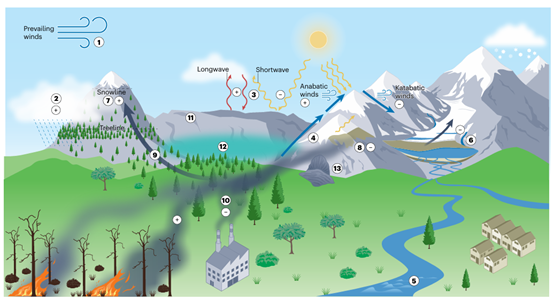
A new Nature study reveals Elevation-Dependent Climate Change (EDCC): mountains like the Tibetan Plateau warm 0.21°C/century faster than lowlands. Glacial melt, erratic rain, and ecosystem shifts threaten billions relying on these “water towers.”
Ever hiked a mountain and noticed how the weather changes with every step? Turns out, climate change is amplifying that shift—mountains are warming faster than lowlands, and the consequences reach far beyond their peaks. A groundbreaking Nature Reviews Earth & Environment study led by Nick Pepin and colleagues, plus new findings in Nature, lays bare this “elevation-dependent climate change” (EDCC)—a phenomenon that’s reshaping iconic ranges from the Rockies to the Tibetan Plateau .
What’s EDCC, and Why Does It Matter?
EDCC means climate change hits harder at higher elevations. Globally, from 1980 to 2020, mountains warmed 0.21°C per century faster than nearby lowlands—enough to melt glaciers, dry soils, and disrupt the water cycles billions depend on . Precipitation is getting messier too: mountains now see more unpredictable rain, and snow is turning to rain even at high altitudes, robbing ecosystems of critical winter moisture .
Why the speedier warming? Blame the “snow-albedo feedback”: as temperatures rise, snow melts to expose darker soil or rock. These darker surfaces absorb more sunlight, which melts more snow—and the cycle speeds up . It’s a domino effect that’s especially intense in regions like the Tibetan Plateau, where snow and ice cover is massive.
The Tibetan Plateau: A “Water Tower” in Crisis
The Tibetan Plateau—often called “Asia’s Water Tower”—is a frontline for EDCC. Local data tells the story: from 1961 to 2022, the plateau warmed 0.37°C per decade—faster than the global average . Its glaciers are vanishing fast: between 1985 and 2020, glacier area shrank by 18%—that’s 414.8 square kilometers lost every year .
This isn’t just a mountain problem. The plateau feeds 10 major rivers, including the Yangtze and Ganges, supporting over 1.4 billion people. Short-term, more glacial melt might mean extra water—but long-term, empty glaciers will lead to severe droughts . Worse, EDCC is fueling extreme weather: in 2025, Pakistan’s deadly monsoons (linked to plateau-driven rain patterns) killed over 1,000 people, a stark reminder of how mountain climate change ripples outward .
It’s Not Just the Plateau—Mountains Everywhere Are At Risk
The study isn’t limited to Asia. The Rockies in North America are warming 0.73°C per century faster than lowlands, drying forests and worsening wildfires . In the European Alps, snowfall has dropped 80% in some low-elevation areas, endangering ski ecosystems and water supplies . Even the Andes—home to tropical glaciers—are losing ice so fast that communities face water shortages within decades .
What Can Young People Do?
You don’t need to be a scientist to help. Start by learning: follow groups like the Global Mountain Initiative to stay updated. If you hike or camp, stick to trails to protect fragile alpine plants—they’re already stressed by EDCC. Advocate for climate action too: mountains need global policies that cut emissions and protect high-elevation ecosystems.
Mountains are more than scenic backdrops—they’re life support systems. The EDCC crisis is a warning: if we let mountains warm unchecked, the water, food, and weather stability billions rely on will vanish. But it’s not too late. Young people’s voices and actions can push for change—because keeping mountains healthy means keeping our planet healthy.
Reference
Pepin, N., Wu, C., Acil, N., et al. (2025). Elevation-dependent climate change in mountain environments. Nature Reviews Earth & Environment, https://doi.org/10.1038/s43017-025-00740-4
Nature. (2025). Climate change intensifies faster in mountain environments: Implications for global water and ecosystems.


Leave a Reply